What Christmas in Lisbon told me about cars
My thoughs about Portugal's management of urban mobility and a more sustainable car park.
Christmas is usually associated with family dinners, shared time, and a welcome pause from everyday routines; sometimes even with the perfect excuse to plan one last trip before the year ends.
My fiancée and I spent the last four days of 2025 in Lisbon, celebrating both ourselves and the end of a particularly good year. As first-time visitors to Portugal, we were immediately drawn to the city’s charm, its rhythm, and its unmistakable character. However, beyond the scenery and atmosphere, Lisbon surprised me in a more unexpected way: through its easy and cheap mobility and the way electric vehicles are seamlessly integrated into it.
Our first pleasant surprise came before we had even reached the city. The ride from the airport to central Lisbon cost less than 11€ for a journey of roughly 9km and 20 minutes, around three times cheaper than a comparable ride in our hometown, Barcelona.
Pickup was smooth and straightforward, and the car that welcomed us was a Tesla Model X, not one very well conserved to be honest, but it served us to get fast and easy to our hotel. Zero local emissions, a high level of comfort, and a very reasonable price made for an unexpectedly strong first impression and an excellent introduction to the city’s approach to everyday mobility.
As we tend to do when traveling, our initial plan was to explore the city mostly on foot and by using public transportation. One of the Lisbon experiences we were keen not to miss was hopping on its iconic yellow trams, so we took a closer look at the available transport options. A single journey on the metro or bus costed 1.72€ with the Viva Viagem Card, while a 24 hour ticket covering metro, buses and urban CP trains is priced at 11,40€.
When compared with Barcelona, however, the prices for public transportation were not that good and the network felt less complete. In Barcelona a 10 trip T-casual ticket is priced at €12.55 (1,255€ each journey). At the same time, visitors can opt for a Hola Barcelona three day card for less than €25, which offers unlimited travel during the stay. From a public transport perspective, this is one area where Barcelona arguably offers better value and flexibility for short city breaks.
After leaving our bags at the hotel, we set out on foot to explore the city center and tick off the first locations on our checklist. It was during this initial walk that I began to notice something increasingly familiar: the high presence of electric vehicles on the road, not only among ride-hailing services but also among private owners. (Admittedly, noticing cars may not be the most common tourist activity, but working for a car company comes with certain unavoidable side effects)
From older and more affordable Renault Zoes to far more advanced XPENG models, passing through the full range of Tesla and BYD offerings, battery-electric vehicles were everywhere. No matter where you looked, at least a couple of BEVs were sharing the streets with the still-dominant internal combustion engine vehicles. And this observation applies only to cars, because it wasn’t long before we encountered another, very Lisbon-specific phenomenon: the tuk-tuks.
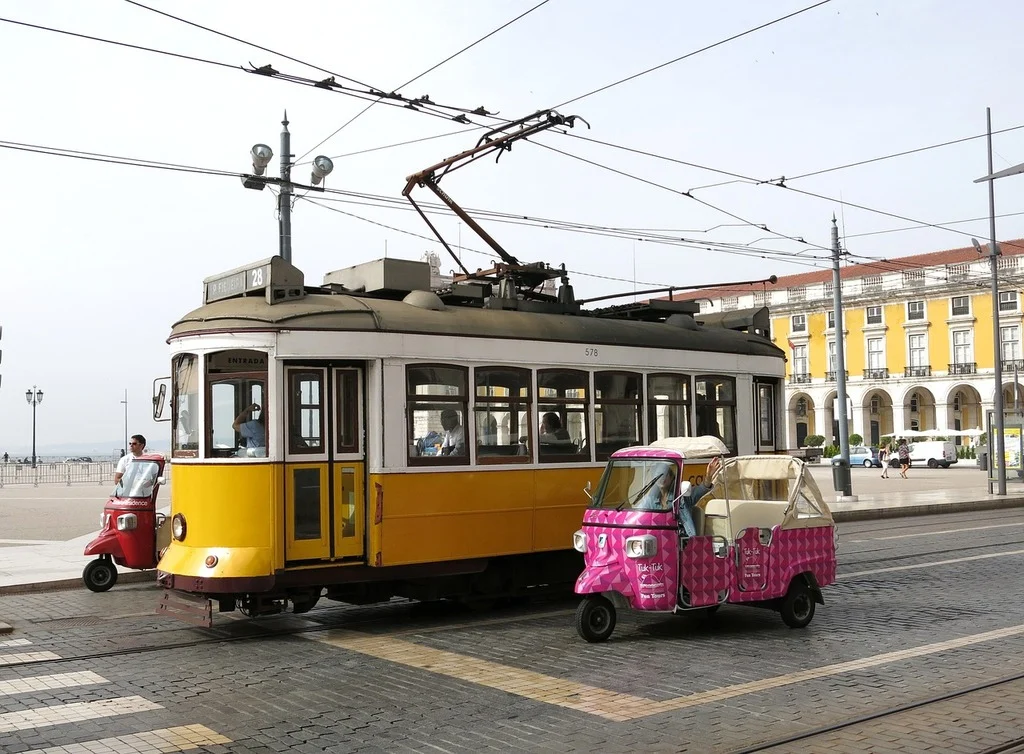
Lisbon is full of these open vehicles, sometimes with three wheels, sometimes more, ferrying tourists through the city’s narrow streets. They offer guided tours of the main landmarks while enthusiastically sharing local history, and, just as importantly, recommending the best spots for ginjinha and pastéis de Belém along the way. An overwhelming majority of them are electric, to the point where spotting one still running on fossil fuels felt more like the exception than the rule. Not to also mention the hundreds of electric scooters spread along the city.
Lisbon really moves on electric wheels!
We ended our walk with some incredible views at one of Lisbon’s most famous viewpoints, the Miradouro de São Pedro de Alcântara. By then it was already getting dark and we were noticeably tired, so we ordered another electric Uber, this time a more modest Renault Zoe.
Our driver, Armando, a very friendly local, did far more than simply take us back to the hotel. Along the way, he pointed out landmarks and explained what we were passing by with the ease and enthusiasm of a top-tier guide. It was a small, unplanned highlight of the evening, and one that earned him a well-deserved tip.
The ride costed less than 5€ (excluding the tip) for a 3.8km, 24 minute journey. Once again, it was a great experience at a remarkably reasonable price, and a fitting end to our first day exploring Lisbon’s streets.
Our second day began on foot, wandering through the narrow streets of the old town, visiting the Castelo de São Jorge, and tasting our first bifanas, an iconic Lisbon sandwich that quickly became my main source of calories for the remainder of the trip. Simple in appearance but surprisingly rich in flavor, a bifana consists of thin slices of pork simmered in a garlicky, lightly spiced sauce and served inside a crusty bread roll. It is inexpensive, fast, and deeply rooted in local food culture, the kind of dish that feels less like street food and more like a daily ritual for many Lisbon residents.
After refueling, it was time for the long-anticipated yellow tram experience. Boarding one of Lisbon’s historic eléctricos felt like stepping into a moving postcard. Originally introduced in the early 20th century to tackle the city’s steep hills and tight corners, these trams remain an essential part of Lisbon’s public transport network. As we crossed the city at a deliberately unhurried pace, the tram offered a distinctly bohemian way of moving around, effective, atmospheric, and deeply connected to the city’s identity. More than just transportation, it was a chance to experience a living piece of Lisbon’s heritage while gliding through neighborhoods that would be difficult to navigate any other way.
We began our third day with a trip to Belém (once again in a very affordable and pleasant Renault Zoe Uber) where we visited the main attractions and enjoyed a seaside walk along the Tagus riverfront. After that, we booked another Uber to reach our next destination: the LX Factory.
This time, the car that picked us up was a BYD Seal, a model I had been particularly eager to experience for several months and one I was genuinely curious to discuss with a real owner. And who better than an Uber driver who had been living with the car for over half a year?
The car made a strong impression from the very first moments. The equipment felt like a thoughtful combination of high-quality materials and advanced technology: large (and rotating) screens, a panoramic roof, ventilated seats, the list of features could go on for quite some time, and most importantly, everything both looked and felt well executed. Our driver, José, was clearly in love with the car. He explained that he had previously owned a Tesla Model 3 and that he was significantly happier with the BYD. Despite having already accumulated a considerable number of kilometers, he described it as comfortable, quiet, and perfectly suitable for family trips, with no compromises in everyday usability.
This experience inevitably brought me back to our first Tesla ride from the airport to the hotel. That Tesla felt noticeably worn. I did not ask the driver how long he had owned it, but from the back seat I could clearly feel (and hear) vibrations coming from the electric motors behind me, something that should not be present in a modern EV. The steering wheel and seats also showed visible discoloration, even though the infotainment system still felt as impressive as on day one.
The contrast between both experiences was striking: one car felt solid, refined, and aging gracefully, while the other felt tired, overstressed, and prematurely worn despite its technological strengths.
LX Factory was a super enjoyable experience. Essentially, it’s an old factory complex transformed into a vibrant contemporary urban art center, brimming with alternative restaurants, artist workshops, bookstores, fashion showrooms, and galleries. Walking through its walls, exploring artwork, boutiques, and cafés, felt like a refreshingly creative and unconventional way to spend our last afternoon in Lisbon.
To round off our final day, we headed to Lisbon’s Christmas Market at Parque Eduardo VII, one of the largest in Europe. The festive atmosphere was alive with the usual delights: bifanas, ginjinha, pastéis de Belém, and steaming cups of hot wine. Yet even there, the city’s electric mobility culture made itself felt: various energy companies had set up brand activations showcasing new plans and products, including EV solutions, highlighting how sustainability and innovation have become part of Lisbon’s public consciousness.
Our last Uber ride was the 31st of December from the Calouste Gulbenkian Museum (an outstanding contemporary art museum) to the airport. This time, the car was a much more well maintained Tesla Model 3, and our driver, António, took full advantage of the ride to showcase all its entertaining features, including the infamous Tesla Fart Mode, which he confessed he occasionally uses to have some fun with his kids.
According to Electromaps, the city of Lisbon has more than 1.122 electric vehicle charging points, less than half of the ones that Barcelona has according to the same source. As highlighted by Polígrafo Portugal registered in 2024 nearly four times the percentage of new electric vehicles relative to total car registrations compared to Spain.
This apparent paradox (fewer charging points but much higher adoption) illustrates that infrastructure alone is not the only factor driving electromobility. Portugal has achieved this level of EV penetration through a combination of strong government incentives, including purchase subsidies and tax benefits, progressive urban policies encouraging EV use in cities, and a cultural openness to electric mobility, as evidenced by the ubiquity of EVs in Lisbon’s streets and ride-hailing fleet.
Spain, by comparison, could learn from Portugal’s approach. Greater coordination of incentives, more flexible urban policies, and public awareness campaigns could encourage drivers to embrace EVs even before infrastructure reaches critical mass. Portugal demonstrates that with the right regulatory framework and social mindset, electromobility can rapidly become a reality, something we experienced firsthand during our short stay in Lisbon, where EVs felt like an integral part of everyday life rather than an exception.
I truly hope that 2026 will be the year of the electromobility revolution in Spain and across Europe. With exciting launches like the CUPRA Raval and the VW Group’s Urban EV family, there are strong drivers pushing the shift toward cleaner, smarter, and more accessible electric vehicles.
For me, Lisbon was a vivid reminder that the future of mobility is already here, it just needs the right incentives, infrastructure, and mindset to take hold.
And now I turn the question to you: what’s your electromobility wish for 2026?
Enjoy Reading This Article?
Here are some more articles you might like to read next: